The intersection of biotechnology and fashion has reached a dazzling new frontier with the debut of living moss dresses and photosynthesis-powered accessories at this year’s BioTech Fashion Week. Designers and scientists alike are hailing the event as a watershed moment, where the boundaries between organic life and wearable art blur in ways previously confined to science fiction. The runway, once a platform for static fabrics, has transformed into a living, breathing ecosystem.
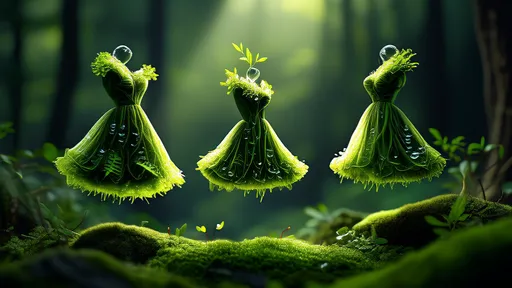
At the heart of this revolution is the living moss gown by avant-garde designer Elara Voss. Woven into a delicate biopolymer mesh, the dress sustains its vibrant green hue through a symbiotic relationship with the wearer. Tiny irrigation channels and nutrient gels embedded in the garment’s structure keep the moss thriving for up to three weeks. "It’s not just clothing—it’s a dialogue with nature," Voss explained backstage, adjusting a frond of Bryum capillare that curled elegantly over a model’s collarbone. Critics noted how the moss responded to ambient humidity during the show, its texture shifting subtly under atmospheric changes.
Meanwhile, Berlin-based collective Photosynth unveiled their "Chlorophyll Couture" line—accessories that generate energy through photosynthesis. Their showstopper was a handbag lined with genetically modified algae cells, capable of converting sunlight into enough electricity to charge a smartphone. The algae, suspended in a flexible hydrogel, pulsated gently under runway lights. "We’ve hacked the photosynthetic process to output 5V," said lead bio-engineer Dr. Felix Reinhardt, demonstrating how the bag’s USB port powered a neon-lit fascinator. Early adopters will need to mist their accessories weekly, turning maintenance into a ritual of care.
The ethical implications are as complex as the technology. While some celebrate these innovations as a leap toward sustainable fashion, others question the morality of using living organisms as decorative elements. Dr. Amina Khoury, a bioethicist at the Geneva Institute, raised concerns during a panel discussion: "When we engineer life to serve aesthetic purposes, where do we draw the line between symbiosis and exploitation?" Designers countered by highlighting their closed-loop ecosystems—the moss dresses can be composted, and the algae bags spawn new generations of cells when returned to designated bioreactors.
Behind the scenes, the technical challenges were staggering. The living garments required climate-controlled dressing rooms with precise humidity levels. Models underwent briefings on "movement moderation" to avoid damaging delicate biological components. "Walking in a photosynthesizing corset feels like wearing a greenhouse," confessed Brazilian model Rafaela Costa after her walk. "You become hyper-aware of your body’s heat and moisture."
Market viability remains uncertain. While the moss dress carries a $12,000 price tag and requires a dedicated "garment gardener" for upkeep, startups are already prototyping scalable solutions. Barcelona’s BioThread announced a DIY moss-kit version for home growers, complete with nutrient sprays and smartphone-controlled terrarium hoods. "We imagine a future where people cultivate their wardrobes alongside herb gardens," said CEO Marco Velasco.
The cultural ripple effects extend beyond fashion. During the closing ceremony, performance artist Yiyun Li staged a provocative piece where her moss-covered bodysuit gradually withered under red-tinted lights—a commentary on climate change’s accelerating pace. As the last fronds turned brown, the audience sat in stunned silence, confronted by the fragility of the very systems these technologies seek to emulate.
What began as an experimental niche now threatens to upend fashion’s entire supply chain. If garments can grow rather than be manufactured, the implications for labor, waste, and consumption are profound. As the lights dimmed on BioTech Fashion Week, one question lingered in the air: Are we witnessing the birth of a new aesthetic era, or merely playing Prometheus with the building blocks of life?

By /Aug 18, 2025

By Amanda Phillips/May 27, 2025
By /Aug 18, 2025

By Sophia Lewis/May 27, 2025

By /Aug 18, 2025
By /Aug 18, 2025
By Rebecca Stewart/May 27, 2025

By /Aug 18, 2025
By /Aug 18, 2025
By Christopher Harris/May 27, 2025
By Joshua Howard/May 27, 2025
By Megan Clark/May 27, 2025

By Daniel Scott/May 27, 2025

By /Aug 18, 2025

By Jessica Lee/May 27, 2025
By David Anderson/May 27, 2025

By /Aug 18, 2025
By /Aug 18, 2025

By Noah Bell/May 27, 2025

By /Aug 18, 2025
