In the heart of Beirut, where bullet-riddled buildings stand as silent witnesses to decades of conflict, an extraordinary fashion movement is taking shape. Lebanese haute couture designers have begun transforming the jagged silhouettes of war-damaged architecture into breathtaking garment structures, creating what industry insiders now call "wartime couture". This radical design philosophy doesn't merely draw inspiration from destruction - it physically incorporates the essence of fractured concrete and twisted steel into wearable art.
The movement gained international attention when designer Nadia Zgheib unveiled her "Elegy in Concrete" collection during Paris Fashion Week. Her dresses featured precisely calculated asymmetrical cuts that mirrored the angular gaps in Beirut's iconic Egg building, with fabric folds recreating the collapsed floors of the 1970s cinema landmark. "We're not romanticizing destruction," Zgheib explained backstage, running her fingers along a dress seam that perfectly echoed a famous bullet scar pattern from the Civil War. "We're giving form to collective memory through the most intimate object humans create - clothing that touches the skin."
Architectural historians have noted striking parallels between this fashion movement and Lebanon's actual postwar reconstruction methods. Just as engineers often preserve fragments of damaged structures when rebuilding, these designers intentionally leave "unfinished" elements in their garments. Raw edges mimic exposed rebar, while intricate beadwork replicates the sparkle of broken glass still embedded in building facades. The resulting pieces feel simultaneously fragile and indestructible - much like Beirut itself.
What makes this trend particularly revolutionary is its rejection of traditional Middle Eastern design motifs. Rather than the expected arabesques or ornate patterns, these creations channel brutalist aesthetics through luxurious fabrics. A recent show featured a cashmere gown whose draped neckline precisely followed the leaning angle of a bomb-damaged apartment block in Gemmayzeh, while another designer crafted a corset using 3D-printed panels that reproduced the crack patterns from the August 4 port explosion.
The psychological dimension of wearing architectural wounds has sparked intense debate. Trauma specialists initially expressed concern that the trend might trigger painful memories, but many Beirut residents report the opposite effect. "Seeing our scars transformed into something beautiful feels like alchemy," remarked one show attendee wearing a jacket whose shoulders perfectly mirrored her own bomb-damaged balcony. The garments seem to function as portable memorials, with some clients specifically requesting designs based on buildings connected to personal loss.
Technically, the creations push fashion engineering to its limits. Designers collaborate with architects using photogrammetry to capture building damage with millimeter precision. One atelier developed a specialized draping technique they call "stone folding," creating fabric pleats that hold their shape like collapsed masonry. Another workshop employs aerospace-grade materials to achieve the illusion of floating concrete fragments - a surreal effect that drew gasps during a recent runway show when a skirt appeared to defy gravity just like the precarious remains of the Beirut City Center building.
Critics argue the movement risks aestheticizing tragedy, but its proponents counter that they're practicing a form of sartorial archaeology. "Each dress tells a truth that official histories often smooth over," noted curator Leila Mourani during a museum exhibition pairing actual war-damaged architectural fragments with their couture interpretations. The show demonstrated how fashion can serve as an alternative archive, with garment labels detailing not just materials and measurements, but the exact GPS coordinates of the buildings that inspired them.
As global fashion capitals take notice, Lebanese designers remain fiercely protective of the movement's origins. "This isn't just a style - it's our lived experience rendered in silk and organza," stressed Zgheib during a masterclass at the Beirut Design Academy. Students there now learn to analyze structural damage patterns alongside traditional pattern-making, with some assignments requiring them to create wearable interpretations of specific ruined buildings within 24 hours - a metaphor for Beirut's own relentless cycles of destruction and reinvention.
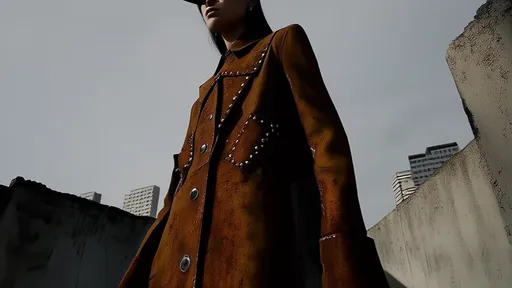
The economic implications are equally fascinating. At a time when Lebanon's traditional industries struggle, these architectural garments command astronomical prices from international collectors. A single "port explosion" inspired coat recently sold at auction for the price of an actual Beirut apartment, creating what economists call a "war premium" in the luxury market. Yet many designers reinvest these profits into community reconstruction projects, blurring the lines between artistic practice and urban activism.
Perhaps most remarkably, the trend has begun influencing actual architecture. Young firms are consulting fashion designers when planning renovations, creating buildings that anticipate their own aesthetic afterlife as potential garment inspiration. In this strange new symbiosis, a dress might one day influence how its architectural muse gets rebuilt - the ultimate fusion of form and memory in a city that refuses to let its wounds define its future.

By /Aug 18, 2025

By Amanda Phillips/May 27, 2025

By /Aug 18, 2025

By Sophia Lewis/May 27, 2025

By /Aug 18, 2025
By /Aug 18, 2025
By Rebecca Stewart/May 27, 2025

By /Aug 18, 2025

By /Aug 18, 2025
By Christopher Harris/May 27, 2025
By Joshua Howard/May 27, 2025

By Megan Clark/May 27, 2025

By Daniel Scott/May 27, 2025

By /Aug 18, 2025

By Jessica Lee/May 27, 2025
By David Anderson/May 27, 2025

By /Aug 18, 2025
By /Aug 18, 2025

By Noah Bell/May 27, 2025

By /Aug 18, 2025
