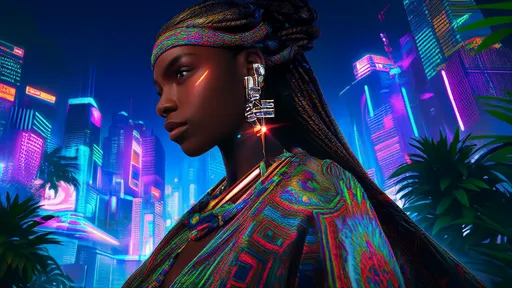
In the bustling markets of Lagos, where the vibrant hues of traditional West African wax prints collide with the neon glow of digital billboards, a new fashion revolution is brewing. A cadre of avant-garde designers is reimagining ancestral textile traditions through the lens of cyberpunk aesthetics, creating what locals are calling "Afro-cyber tribalwear." This movement isn't just about clothing—it's a visual manifesto that interrogates post-colonial identity in the age of artificial intelligence and cryptocurrency.
The air smells of melted beeswax and soldering irons at the Alara Collective studio, where 28-year-old designer Ngozi Okeke hand-paints circuit board patterns onto indigo-dyed adire fabric. "Our grandparents used resist-dyeing to tell stories," she explains, adjusting her augmented reality headset that projects holographic embroidery patterns onto half-finished garments. "Now we're writing new narratives with conductive thread and solar-charged LEDs." Behind her, mannequins draped in fractal-patterned ankara fabrics seem to breathe as embedded fiber optics pulse to the rhythm of a Fela Kuti remix.
This synthesis didn't emerge from vacuum. Lagos has long been a cultural petri dish where centuries-old Yoruba beadwork coexists with pirate satellite dishes and makeshift robotics labs. The city's infamous "computer village"—a sprawling tech black market—has become an unlikely sourcing ground for designers seeking discarded motherboards to repurpose as futuristic jewelry. Meanwhile, traditional indigo pits in nearby Abeokuta now double as experimental labs for creating bioluminescent dyes using genetically modified bacteria.
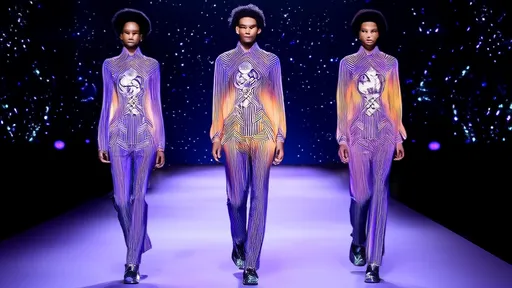
At last month's Lagos Fashion Week, the runway resembled a scene from "Blade Runner 2049" reimagined by Chinua Achebe. Models with facial scarification patterns rendered in electroluminescent wire stomped down the catwalk in gowns that changed color when exposed to Wi-Fi signals. One particularly striking piece—a deconstructed agbada robe with sleeves that transformed into cryptocurrency tickers—went viral across African tech hubs, amassing 2.3 million views on Nairaland within hours.
The movement's philosophical underpinnings trace back to the "Afrofuturism 2.0" debates circulating through Lagos' underground art collectives. Unlike Western cyberpunk's dystopian alienation, these designers articulate what scholar Bayo Akomolafe calls "techno-mysticism"—a worldview where blockchain protocols and ancestral divination systems hold equal explanatory power. Their garments literally weave together these dualities: a single jacket might incorporate GPS-tracked cowrie shells alongside hand-woven kente cloth strips programmed to display Bitcoin prices.
Critics initially dismissed the trend as cultural pastiche, but the economic realities tell a different story. Small-batch "smart ankara" workshops now account for 17% of Lagos' creative sector exports, with demand particularly strong among the African diaspora in Berlin and Brooklyn. The technology isn't just cosmetic either. Designers are collaborating with MIT-trained Nigerian engineers to develop temperature-regulating fabrics using nanotechnology derived from ancient mudcloth preservation techniques.
Perhaps most surprisingly, the movement is sparking unexpected intergenerational dialogues. At the Nike Art Gallery's recent exhibition, elderly Yoruba weavers could be seen nodding approvingly at holographic interpretations of traditional adinkra symbols. "The spirits don't care if your korowodo is made of glass beads or microchips," remarked 76-year-old master dyer Adebayo Ogunlesi, while examining a solar-powered gele headpiece that changed patterns based on weather satellite data.
As multinational tech firms scramble to co-opt the aesthetic—Google recently commissioned a collection of algorithm-generated aso-oke patterns—the Lagos vanguard remains several steps ahead. The most radical designs now incorporate facial recognition-blocking masks inspired by Egungun ceremonial costumes and "anti-surveillance" prints that confuse AI pattern detection systems. In doing so, they've transformed wax print from colonial commodity to subversive toolkit.
The next frontier? Biotechnology. Startups like BioAdire are experimenting with fungal-based smart textiles that grow their own circuitry, while others explore pheromone-emitting fabrics that recreate the olfactory experience of traditional African markets. As designer Okeke observes while soldering another circuit onto a ceremonial wrapper: "We're not predicting the future. We're hand-sewing it."
What emerges from Lagos' creative crucible is neither nostalgic traditionalism nor uncritical techno-utopianism, but something far more interesting—a vision of the future where the binary between analog and digital, sacred and synthetic, collapses into something wholly new. The cyberpunk writers of the 1980s imagined Tokyo as the nexus of future culture. They might have been looking at the wrong archipelago.

By /Aug 18, 2025

By Amanda Phillips/May 27, 2025

By /Aug 18, 2025

By Sophia Lewis/May 27, 2025

By /Aug 18, 2025

By /Aug 18, 2025

By Rebecca Stewart/May 27, 2025

By /Aug 18, 2025

By /Aug 18, 2025

By Christopher Harris/May 27, 2025

By Joshua Howard/May 27, 2025

By Megan Clark/May 27, 2025

By Daniel Scott/May 27, 2025
By /Aug 18, 2025

By Jessica Lee/May 27, 2025

By David Anderson/May 27, 2025

By /Aug 18, 2025
By /Aug 18, 2025

By Noah Bell/May 27, 2025

By /Aug 18, 2025
